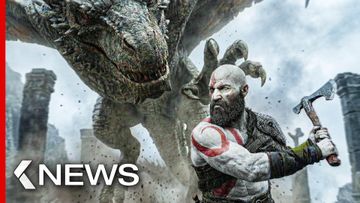
God of War: Actor Found for Kratos!
The casting for Atreus is also already well underway
It's finally official! The cast of Kratos in the "God of War" live-action series has been confirmed. As Deadline magazine revealed, Ryan Hurst will take on the role of the grumpy Spartan. Hurst first attracted attention as Opie Winston in "Sons of Anarchy". He is also very familiar with the "God of War" universe: in 2022, he voiced Thor in "God of War: Ragnarok". Atreus, son of Kratos, is to be played by a 9 to 12-year-old boy. The character is described as "intelligent, curious and emotionally neglected".
According to showrunner Ronald D. Moore, the series will be based on the games, but will not be a 1:1 adaptation. The story centers on the journey of Kratos and his son Atreus, who want to scatter the ashes of his wife and mother Fayes. Kratos tries to teach his son to become a better god, while Atreus wants to show his father the way to more humanity. And of course, the two also have to deal with all kinds of dangers and enemies.
The first season will probably consist of ten episodes. But it is already clear that it will not stop there. Amazon has already commissioned a second season. Pre-production is already underway in Vancouver. It is not yet known exactly when filming will begin. A start date has also not yet been set.
Why God of War is perfect for a series
Hardly any video game series of the last two decades has undergone such a profound development as "God of War". What began as an uncompromising action experience with mythological overtones is now an emotional epic about guilt, responsibility and family. It is precisely this narrative maturity and complexity that is perfect for a series adaptation.
A story that takes time
A decisive advantage of the series format lies in the narrative space. "God of War" thrives on long-term developments, inner conflicts and moral gray areas. Kratos' path from vengeful warrior to thoughtful father is not a sudden change, but a painful process. A series can tell this development step by step without simplifying or accelerating it. While a movie could only touch on many stages, a series allows Kratos' past, his guilt and his inner turmoil to be explored in detail.
Kratos: A hero beyond the classic clichés
Kratos is not a shining figure of identification, but a broken character. He is characterized by violence, loss and decisions that haunt him to this day. It is precisely this ambivalence that makes him so fascinating. In the series format, his taciturnity, his outbursts of anger and his moments of remorse can have a stronger impact because they don't have to be constantly overshadowed by action. Series offer space for quiet scenes – and it is precisely there that Kratos unfolds his greatest impact.
The father-son relationship as an emotional center
The relationship between Kratos and his son Atreus is at the heart of the more recent "God of War" stories. This dynamic gives the series an emotional depth that goes far beyond classic revenge motifs. Kratos wants to protect his son and at the same time prevent him from repeating his own mistakes. Atreus, on the other hand, seeks recognition, answers and his place in the world. This relationship develops slowly, full of conflict and credible – ideal conditions for serialized storytelling over several episodes.
Atreus as an independent character
Atreus is far more than just a companion. He is a character with his own personality, his own doubts and a clear development. His growing up, his handling of power and knowledge and his questions about identity and responsibility provide plenty of material for a series. The series format in particular makes it possible to shed more light on Atreus' perspective and give him room to develop without losing the focus of Kratos.
Mythological worlds full of stories
The world of "God of War" is deeply rooted in Greek and Norse mythology. Gods, monsters, prophecies and ancient conflicts form a rich universe that literally begs to be explored. A series can unfold this world piece by piece, introduce secondary characters and deepen mythological backgrounds. Flashbacks, subplots and stand-alone episodes bring the universe to life and create an epic breadth that works particularly well in the series format.
The perfect balance of intimacy and spectacle
"God of War" impresses with the contrast between quiet, emotional moments and monumental action sequences. Conversations about loss and responsibility are on an equal footing with battles against gods and beasts. Modern series have shown that it is precisely this mix that goes down particularly well with audiences. The format allows action to be used in a targeted manner without neglecting the emotional level.
At its core, "God of War" tells a story about parenthood, trauma and the attempt to break one's own cycle of violence. These themes are universal and appeal to an adult audience. Kratos fights not only mythological foes, but his own past.
Cinematic DNA for the series format
The games themselves already have a strong cinematic feel. Long tracking shots, detailed environments and a dense atmosphere form an ideal basis for a high-quality series adaptation. At the same time, the format allows different realms and locations to be explored bit by bit without having to "work through" them in a short space of time.
Conclusion: material made for a series
"God of War" combines strong characters, emotional depth, mythological grandeur and timeless themes. All of these elements unfold their full effect, especially in the series format. The story of Kratos and Atreus is complex, multi-layered and human – despite or precisely because of its divine dimension. This is precisely why "God of War" is not only suitable for a series, but also has the potential to become one of the most impressive game adaptations ever.