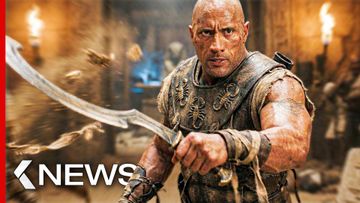
The Brave and the Bold: Screenwriter Hired for New DCU Batman Film
This "Batman" film might turn out to be really dark and gritty!
Finally, some progress on the new DCU Batman! With "The Brave and the Bold", we are getting a second Dark Knight alongside Robert Pattinson – and now it looks like we know who's writing the story.
According to The Hollywood Reporter, DC has tapped Christina Hodson for the job. You might know her as the writer of "The Flash" and "Birds of Prey". Insiders say she has actually been working on the script since at least the fall! The exciting part: we are finally getting a dynamic duo again! Batman meets his biological son Damian Wayne as Robin. But Damian was raised by assassins and is extremely brutal. And Bruce wasn't even aware of his existence until the events of the film.
The project is still set to be helmed by "The Flash" director Andy Muschietti – provided he has enough time for it. He is currently very busy with his involvement in the "It" universe: for instance, the second season of "Welcome to Derry" has just been confirmed.
Batman: The Dark Knight's special place in the superhero genre
Batman has played a special role in the superhero genre for decades. While many heroes are defined by superhuman abilities, extraterrestrial origins or divine powers, Batman remains deliberately human. His stories are less fantasies of power than psychological studies of fear, trauma and morality. This combination makes the Dark Knight one of the most complex and changeable characters in pop culture.
A hero without superpowers
One of Batman's most striking characteristics is his lack of classic superpowers. Bruce Wayne cannot fly, has no superhuman strength and is not invulnerable. His abilities are based on intelligence, years of training, discipline and state-of-the-art technology. This makes Batman more tangible than many other superheroes. Christopher Nolan's "Batman Begins" (2005) places great emphasis on this aspect. The film shows the long journey from traumatized child to masked avenger. Bruce Wayne fails, doubts and has to learn to control his fear. Batman is not born here, but created – a decisive difference to many other heroic figures.
Batman as a symbol of fear
Batman is more than just a person, he is a symbol. Bruce Wayne uses the mask and his nocturnal appearance to spread fear among criminals. In a city characterized by corruption and violence, Batman becomes an urban legend. In "The Dark Knight" (2008), this symbolic dimension becomes particularly clear. Batman understands that he himself does not have to be the hero as long as Gotham retains hope. At the end of the movie, he sacrifices his reputation to preserve the image of Harvey Dent. Batman becomes the "Dark Knight" who acts in the shadows so that others can stand in the light.
Moral gray areas instead of clear hero ethics
Unlike many superheroes, Batman is constantly operating in morally gray areas. He breaks laws, uses violence and does not shy away from questionable methods. His famous rule not to kill is less an expression of moral purity than a self-imposed restraint to avoid losing control completely.
A striking example is again "The Dark Knight", in which Batman uses a comprehensive surveillance system to find the Joker. The movie does not portray this measure as heroic, but as ethically problematic. Batman wins, but at a high moral price – a motif that is rarely treated so consistently in the superhero genre.
The villains as a mirror of his psyche
Batman's adversaries are another key to his uniqueness. Many of his enemies do not possess superhuman powers, but embody extreme psychological or ideological positions. They act as mirrors of Batman's inner conflicts.
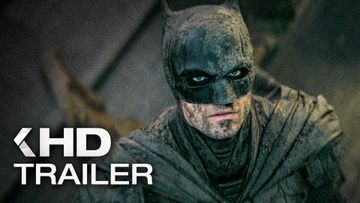
The Joker stands for chaos and senselessness, Two-Face for the moral decay that can arise from idealism. In "The Batman" (2022), the Riddler is staged as a radicalized distorted image of Batman: Both use masks, both see themselves as avengers, both believe they are morally in the right. The film poses the uncomfortable question of whether Batman's methods themselves promote violence and fanaticism.
Stylistic changeability of the character
Hardly any other superhero is as stylistically versatile as Batman. The character works in a wide variety of tones and genres. Tim Burton's "Batman" (1989) focused on a dark, expressionist aesthetic, while Joel Schumacher created a garish, exaggerated comic world in the 1990s with "Batman Forever" and "Batman & Robin".
Later, Christopher Nolan and Matt Reeves brought Batman closer to realistic thriller and noir structures. Despite these extremely different approaches, Batman remains recognizable as a character – proof of his extraordinary narrative flexibility.
Trauma as a central motivation
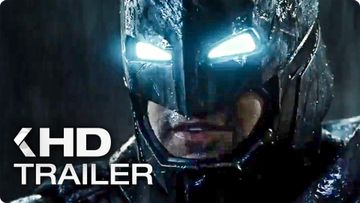
At the heart of all Batman stories is a trauma: the murder of Bruce Wayne's parents. This event is not just a background story, but the emotional motor of the character. Batman is not a hero out of a sense of duty, but out of pain. "Batman v Superman: Dawn of Justice" (2016) shows an older, disillusioned Batman whose trauma has never been dealt with. He is distrustful, brutal and willing to cross moral boundaries. This portrayal is polarizing, but shows how consistently Batman's psychological depth can be taken further.
Timeless relevance and social reflection
Batman is also unique because he always reflects the fears and conflicts of his time. Topics such as terrorism, surveillance, social inequality and the abuse of power find their way into his stories time and again. As a result, Batman not only remains relevant, but also evolves with society.
Conclusion: More than just a superhero
Batman is not a classic superhero, but a figure between myth and humanity. He embodies fear and hope at the same time, moves between right and wrong and forces his audience to ask uncomfortable questions. It is precisely these contradictions that make him one of the most fascinating and enduringly relevant characters in the superhero genre – both in comics and on the big screen.