Opinion: Why Christopher Nolan's The Odyssey is so successful
The film taps into the audience's subconscious longing
It is an idea of timeless ingenuity. An idea that Christopher Nolan also explores in his film adaptation of Homer's "The Odyssey." The Trojan Horse. Odysseus leads his enemies to believe that it is a gift, an offering to the goddess Athena. In reality, he and his men are hiding inside the giant wooden horse. The Trojans accept the supposed gift – and thereby bring about their own downfall. When darkness falls, the men emerge from their hiding place, kill the guards, and open the city gate to let the rest of the army in. The plan succeeds, and Odysseus wins the war.
In Nolan's interpretation of the 3,000-year-old epic, the Trojan Horse plays a central role. At the same time, it impressively embodies the approach of this filmmaker, who always relies on real sets and real people. He prioritizes craftsmanship over computing power. Consequently, his films are elaborate and expensive. But the success proves the director and screenwriter right. Following "Oppenheimer," he once again landed a massive box-office hit with his film adaptation of "The Odyssey." Just a few weeks after its release, the film has already grossed nearly one billion U.S. dollars worldwide. People are flocking to the theaters. They want to know what the film is all about. They want to be part of the conversation. But why, exactly? The story is, after all, ancient.
A longing of the audience
It tells the story of the wanderings of a hero who, after the war, finally wants to return home. Odysseus wants to see his family again – the people he loves. It's a film that, "despite all the monsters and wonders, is about longing," as journalist and film scholar Marcus Stiglegger writes. And a certain longing might also have something to do with Nolan's success. Perhaps people are flocking to the films of this gifted director precisely because he succeeds in catering to a subliminal longing among viewers – one that is growing in the age of artificial intelligence.
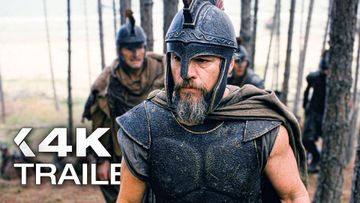
In the face of algorithms and deepfakes, there is something uplifting about seeing the result of genuine, human craftsmanship on the screen. Take, for example, the Trojan Horse by production designer Ruth De Jong, 36 foot tall and weighing 8,800 pounds. Not to mention the art of acting: In the best moments, the precise performance of Matt Damon, who plays Odysseus, reveals a deep-seated despair that AI could never comprehend.

Trojan Horses of a different kind
These days, however, we don't just encounter Trojan horses on the screen. Sometimes they also come in the form of a supposed "film review" that serves merely as a poor cover for reactionary hostility. Christopher Nolan's "The Odyssey" faced significant backlash from right-wing circles even before its release. The main points of contention were the casting of Lupita Nyong'o, who plays Helen of Troy and Clytemnestra, and the casting of Elliot Page, who portrays Sinon. For the "critics," this was a welcome opportunity to vent their frustrations on social media through racist and transphobic comments. One particularly prominent figure: the richest man in the world. Elon Musk also gave free rein to his resentment, not only railing against the film but also announcing an alternative version of the story – created using his AI image and video generator, Grok Imagine. On social media, he wrote:
"Before this year ends, Grok Imagine will make a full-length movie of The Odyssey that is historically accurate and true to the art of Homer."
He also shared a video from another account, apparently as a preview of where this might be headed. The three-minute clip shows an AI version of the "Odyssey," which is also said to have been created using Grok Imagine. The result isn't that great.
What AI will never be
Given this AI "Odyssey," Nolan's fans can sit back and relax. But for how much longer? Perhaps at some point the result will seem so realistic that we'll no longer be able to tell whether a film was generated by AI or created by humans – directors, actors, production designers. There's no question: AI is becoming more sophisticated. But there's one thing AI will never be: Christopher Nolan.
Ultimately, he is the most compelling reason to go to the movies. AI may one day be able to simulate the men inside a 36 foot tall, 8,800-pound Trojan horse with deceptive realism. But the specific, individual vision of "The Odyssey" that Nolan has conceived – his humanistic understanding of the material – cannot be replaced by any AI in the world. That's why people are flocking to the movies. That's why they want to have a say. Most people aren't necessarily looking to see the latest "Oppenheimer" movie or the latest "Odyssey" adaptation. They're interested in Nolan's latest work. They want to find out what idea of timeless ingenuity he'll surprise us with this time.
My prediction: Musk's AI version of "The Odyssey" won't interest anyone. People will still be talking about Nolan's film adaptation even 3,000 years from now. If I'm wrong, I'll formally apologize at that time.