Tilly Norwood & Co: How AI Is Changing Hollywood
Artificial intelligence is making its way into the world of film – often quite inconspicuously
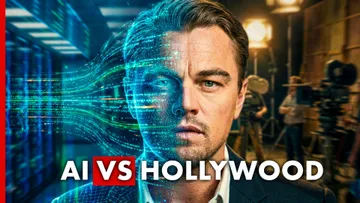
Hollywood is afraid of one woman. What's special about her is that she isn't real. She is the AI-generated actress Tilly Norwood, created by the production company Particle6. Its founder, Eline Van der Velden, claimed at the Zurich Film Festival that several agencies were already interested in the AI actress. This caused an outcry in the film industry.
The U.S. actors' union SAG-AFTRA promptly issued a critical statement: "'Tilly Norwood' is not an actor, it's a character generated by a computer program that was trained on the work of countless professional performers – without permission or compensation."
Hollywood stars also voiced their criticism, including "Poker Face" star Natasha Lyonne and Emily Blunt. According to Lyonne, any talent agencies working with Norwood should be boycotted. Blunt also expressed her dismay:
"That is really, really scary. Come on, agencies, don't do that. Please stop. Please stop taking away our human connection."
SAG-AFTRA's reaction reflects the anger and insecurity of an industry that fears for more than just its jobs. With the rapid advancement of artificial intelligence, the very foundation of Hollywood is at stake: human creativity. Tilly Norwood is just the tip of the iceberg. AI has long since found its way into the film industry. In many cases, it has done so in very subtle ways, so much so that viewers hardly notice it. In this article, we take a closer look at the phenomenon and show where AI is already playing a role in Hollywood!
Use of AI in Oscar films
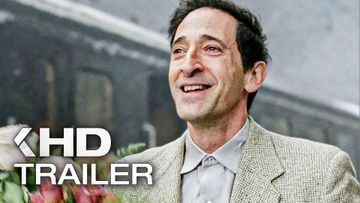
AI is even being used in acclaimed dramas such as "The Brutalist". Brady Corbet's movie about a Hungarian architect who emigrates to the United States after World War II was one of the most-talked about Oscar contenders of 2025. In fact, lead actor Adrien Brody won the coveted trophy for Best Actor. However, the film already sparked controversy beforehand because Brody's pronunciation had been enhanced. With the help of an AI tool called Respeecher, his Hungarian dialogues were made to sound more authentic. It was just a matter of nuances, fine-tuning the pronunciation of certain vowels and consonants. Still, it caused a chorus of outrage. Suddenly, the authenticity of Brody's highly praised performance was called into question. The fact that the actor had painstakingly prepared for his role and the associated Hungarian pronunciation became a minor matter.
Respeecher was also used in Jacques Audiard's musical "Emilia Pérez". In this case, the tool was used to refine the pronunciation in the singing performances of lead actress Karla Sofía Gascón. As in the case of "The Brutalist", this likely goes unnoticed by the audience. Nevertheless, this raises questions about the credibility of an acting performance. Especially when the viewer cannot clearly distinguish between what is real and what is AI-generated. More importantly, it fuels the fear that this is only the beginning of a radical change. A change that could eventually render real actors unnecessary, replaced by a multitude of Tilly Norwoods.
The Immortals: De-Aging and Digital Resurrection
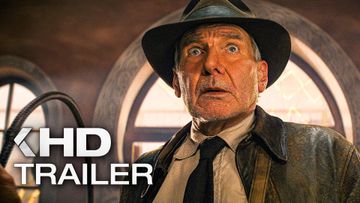
To some extent, however, AI also supports existing tools - especially in the area of CGI. Do you remember Harrison Ford in "Indiana Jones and the Dial of Destiny"? The first 20 minutes of the movie showcase an Indy in his prime. This is not a mask; it's pure computing power: AI analyzed thousands of hours of old footage of the actor and overlaid a younger version onto his current face.
This sounds technically fascinating, but it raises new questions: if we can digitally rejuvenate actors or even bring back the deceased – then where's the need for new talent? Will we only see movies with the same 20 superstars in the future? If the audience only wants nostalgia, AI will deliver exactly that – over and over again. So, even more repetition in Hollywood – one of the biggest criticisms in recent years.
Computer-Generated Art
But the increasing influence of artificial intelligence is not just a concern for actors. Artists behind the camera are also worried about current developments in Hollywood. A prominent example is the Marvel production "Secret Invasion". More specifically: the intro to the streaming series. Because it was generated with AI, it didn't take long for people to get upset. This was also evident from the reaction of concept artist Jeff Simpson, who had worked on the series for almost half a year and then voiced his frustration in a social media post:
"Secret Invasion intro is AI generated. I'm devastated, I believe AI to be unethical, dangerous and designed solely to eliminate artists careers."
Incidentally, the Marvel series starring Samuel L. Jackson centers around an alien conspiracy in which humans are replaced by shape-shifting aliens. What a bitter irony, considering the artists who fear being replaced by AI themselves.
The Manipulation of Finished Films
Artificial intelligence also influences the post-production editing of films that have already wrapped filming: one example is dubbing. We are all familiar with this: often, the audio doesn't quite match the lip movements when watching a film in a different language.
New AI tools like TrueSync radically change that. They retroactively adjust the actors' lip movements in the footage to match the spoken language of the dubbing actors. This completely blurs the lines between the original and the edited version.
Things got even crazier with the thriller "Fall". The movie was originally full of profanity, which would have resulted in an R rating in the United States – meaning less revenue. Instead of expensive reshoots, they used AI to digitally alter the actresses' lip movements and have them say more harmless words. The result? A PG-13 rated film, without the actors ever having to return to the set. Efficient? Yes. But doesn't this manipulate the original artistic vision?
Screenwriter: ChatGPT
Even greater cause for concern for the U.S. film industry, however, could be a movie from Switzerland. In 2024, the science fiction drama "The Last Screenwriter" was released, with a screenplay entirely written by an AI. In fact, the work of Swiss director Peter Luisi lists ChatGPT 4 as the screenwriter. The film, in turn, centers on a human screenwriter who, in light of artificial intelligence, begins to wonder whether AI is artistically superior to him. As a self-referential experiment, "The Last Screenwriter" has a certain appeal. However, the fact that a complete movie can now be written by AI is unlikely to bring much joy to real scriptwriters. After all, here too we are faced with the question of whether they will ultimately be replaced by artificial intelligence. Because regardless of the quality of the end result, one thing is already certain: if an AI writes the script, producers can avoid spending money on an expensive screenwriter.
AI Means, Above All: Saving Money
And that's what it's all about in the end: maximizing profits. But whether jobs and human creativity fall by the wayside in the process seems to be of little concern to at least one Hollywood star: Ashton Kutcher. The actor sees the future of filmmaking in Sora, OpenAI's generative video tool. In a conversation with former Google CEO Eric Schmidt, Kutcher expressed his excitement about using artificial intelligence to make the film industry significantly more cost-effective:
"Why would you go out and shoot an establishing shot of a house in a television show when you could just create the establishing shot for $100? To go out and shoot it would cost you thousands of dollars."
Hollywood Fights Back
Hollywood trade unions are not quite as relaxed about the whole situation as Ashton Kutcher. In 2023, the actors' union SAG-AFTRA and the writers union WGA went on a months-long strike, during which the regulation of AI was also a central issue. The result: an agreement was reached with the U.S. film studios on certain rules that were laid down in collective bargaining agreements. Among other things, it was decided that actors must give their consent before a digital copy of them can be created by scanning their face and body. However, the contract is only valid for three years. And many minor actors and extras are likely to take this easy money for the scan anyway – thus making themselves redundant in the long run.
The Future of Old Hollywood Is at Stake
Hollywood is gripped by a gold rush, and AI is the shovel. Whether it's Adrien Brody's pronunciation, cheaply produced scripts, or digital extras – the Pandora's box has been opened.
The unions' success was an important victory, a line drawn against total automation. But the question is: how long will this last? Soon, technology will be capable of things we cannot even dream of today.
Of course: cinema has always been an art of magic and illusion. What matters now is: do we want that illusion to be created by people who feel, suffer, and love? Or is a perfect calculation – one that shows us exactly what we want to see – enough for us?